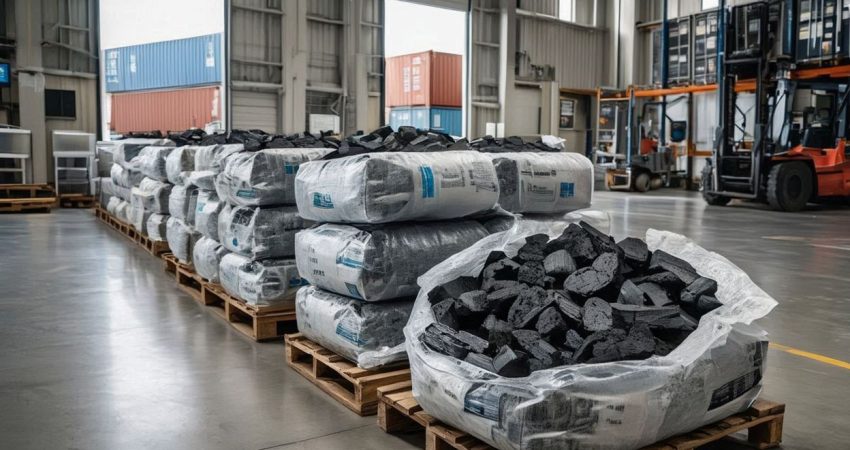
Export quality coconut shell charcoal is a premium carbon material developed to meet the strict requirements of international markets. Today, global buyers increasingly demand stable performance, clean combustion, and consistent specifications. Therefore, coconut shell based charcoal has become a preferred solution for export applications across various industries.
Produced from carefully selected coconut shells, this charcoal delivers high density and strong carbon structure. As a result, it maintains product integrity during long distance shipping. Moreover, buyers can rely on consistent performance once the charcoal reaches its destination.
Key Features of Export Grade Coconut Shell Charcoal
Charcoal prepared for export must meet precise quality benchmarks. For this reason, coconut shell based charcoal is processed to achieve low moisture content, minimal ash residue, and uniform carbonization.
These features allow the product to burn evenly and last longer during use. Consequently, overseas buyers receive charcoal that performs consistently across different climates and storage conditions.
In addition, uniform sizing helps reduce breakage and dust formation during handling and transportation. As a result, product losses remain minimal throughout the export process.
Controlled Manufacturing for Global Distribution
Export grade charcoal begins with strict raw material selection. First, producers collect mature coconut shells from trusted sources. Then, they apply thorough cleaning and drying processes to achieve stable moisture levels.
During carbonization, manufacturers use controlled temperatures with limited oxygen exposure. As a result, volatile compounds are removed while fixed carbon content increases. Moreover, this process improves the overall structural strength of the charcoal.
Many suppliers follow production standards associated with high quality coconut shell charcoal. Therefore, exporters can ensure consistent results for international shipments.
Quality Inspection and International Standards
Before shipment, charcoal undergoes multiple inspection stages. For example, quality teams test ash percentage, moisture level, fixed carbon value, and calorific output.
These evaluations ensure the product meets international buyer specifications and import regulations. Consequently, exporters reduce the risk of rejection at destination ports.
Furthermore, consistent grading helps exporters maintain long term relationships with distributors and wholesalers. Over time, this reliability strengthens trust within global supply chains.
Packaging and Shipping Reliability
Proper packaging plays a critical role in export distribution. Therefore, producers use moisture resistant inner liners combined with durable outer bags to protect charcoal during transit.
Meanwhile, logistics teams carefully manage container loading, sealing, and shipping schedules. As a result, the product arrives at destination ports in stable condition.
In addition, efficient logistics planning supports continuous supply for repeat export orders. Consequently, buyers can rely on steady delivery schedules.
Global Applications and Market Demand
Export grade coconut shell charcoal serves a wide range of international applications. For instance, it is widely used for barbecue fuel, shisha manufacturing, industrial heating, and activated carbon production.
Because of its clean burning behavior and low ash content, many buyers prefer coconut shell based charcoal for premium and regulated uses. Moreover, its stable performance supports demanding industrial processes.
Sustainable Advantages in Export Trade
Coconut shell charcoal supports environmentally responsible trade. By utilizing agricultural waste, producers reduce reliance on hardwood and help minimize deforestation.
Additionally, coconut trees regenerate naturally. As a result, this charcoal represents a renewable energy material suitable for long term use.
As sustainability standards become more important in global markets, coconut shell based charcoal aligns well with international environmental expectations.
Conclusion
Export quality coconut shell charcoal delivers dependable performance, strict quality compliance, and sustainable sourcing for international buyers. Through controlled manufacturing, careful inspection, and secure logistics, this product continues to meet global market demands.
For more information about premium charcoal products and export solutions, visit the official homepage of Doyan Masak.
