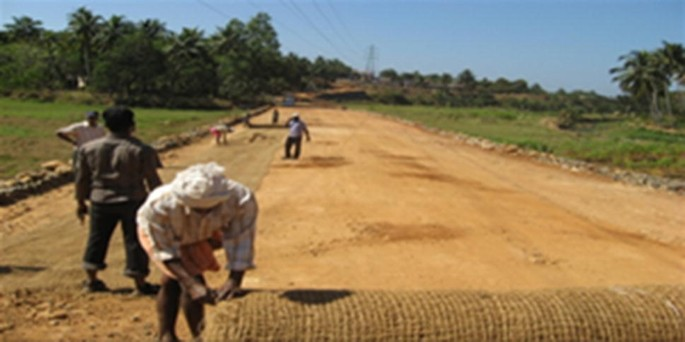
Coir geotextiles in roads – Soil is used worldwide as a construction material for buildings, roads, irrigation systems, and so on. Due to the fragility of its tensile and shear strength, the soil must be improved according to the requirements of the work, which vary from place to place. Soil stabilization has been carried out for many centuries to improve soil engineering properties. The primary stabilization method involves mixing the soil with the highest strength soil or binder materials such as limestone/cement/calcium or reinforcing with appropriate elements/fibers.
Roads laid on BC soil foundations develop ripples in the road surface due to loss of subgrade strength due to softening during monsoon. BC soil is a high clay content soil and a road engineer problem. When dry, it shrinks and becomes so hard that the lumps cannot be easily pulverized for treatment in road construction. But when it gets wet in the rain, it swells, loses strength, and poses a serious problem for subsequent road performance.
All these results crack on roads, so road engineers do not prefer to build roads. However, BC soil has no option, as black cotton soil is available in about one-third of the country. It is often impossible to construct a stable base course on a soft subgrade without losing expensive subgrade material that will infiltrate the soft subgrade; therefore, a soil amendment process must be used.
A Natural Product from Plentiful Resources
Coir geotextiles form one of the largest geosynthetic product groups. One of the most popular applications of geotextiles is the construction of sidewalks and embankments in soft soils. They are materials in the traditional sense, consisting mainly of synthetic fibers. However, natural fibers are also used in their manufacture.
Coconut geotextiles are made by shredding the coconut with a shredding machine to create a small piece of coconut. The coir fiber is then twisted into coir rope using a spinning device. The diameter of the coir rope can be adjusted as needed. After the rope is formed, coir ropes are woven to resemble a net. The thickness of this net can be adjusted as needed.
The material used to make coconut geotextiles is cheap and easy to find. Engineering uses coconut fiber geotextile as a pad or inner layer for the road. It can protect from water runoff and strengthen embankments, filtration and drainage.
Application of Coir Geotextiles in Road Surfacing
Coir geotextiles in roads are spread directly on the surface used as roads. First, the ground is roughly leveled and then a coir net is stretched over it. Coir geotextiles are an alternative solution for road surfacing because they are made from natural materials. The material is strong, but can be degraded by soil. It is safe for the soil’s own ecosystem. It is compared to a mixture of lime, cement, etc.
To improve soil nutrients, coconut geotextile is used after it decomposes. It becomes a nutrient and is beneficial for plant growth. Road application of coir geotextiles has been successful in areas with high compressibility and sloping soils. It is also used for road embankments and areas prone to abrasion and erosion.
Reads also Snack Food Business Package, Little Capital with Big Profits